
Warm White vs. Cool White Christmas Lights: How to Choose

Warm white Christmas lights look soft, yellowish and traditional, like classic incandescent bulbs. Cool white lights look crisp and slightly blue, and they read as more modern. Neither is universally better or brighter. The right choice depends on your house, your existing decorations and the mood you want, so compare the look with your existing decorations before committing.
What “warm” and “cool” actually mean
The difference is called correlated color temperature (CCT), measured in kelvins. The U.S. Department of Energy explains that CCT describes the color appearance of the light source itself, not the color of the objects it lights. Lower CCT looks warmer and more yellow. Higher CCT looks cooler and more blue.
The numbers can be confusing because “warm” sounds hotter than “cool,” and the kelvin scale runs the other way. A candle-like glow sits at the low end. A bluish winter white sits at the high end.
For a general example, the Department of Energy notes that in some white-tunable products warm-white LEDs are usually around 2700K, while cool-white LEDs fall around 5000K to 6500K. Treat those figures as general lighting examples. They are not EZRGB specifications, and individual products from any maker can differ.

The important point is that cool white is not the same as brighter. Tone and brightness are separate things. A warm string and a cool string can have similar output and still feel very different.
How each one looks on a house
The following are style ideas, not rules about which light must go on which house.
| Home or feature | Warm white tends to suit | Cool white tends to suit |
|---|---|---|
| Brick, wood, stone | Yes, it echoes the natural tones | Can feel stark against warm materials |
| White, gray or blue siding | Softer, more nostalgic | Sharp, wintry, clean |
| Wreaths, garland, evergreens | Flatters the greens, reds and golds | Works with a frosty theme |
| Metal railings, bare trees, snowflake shapes | Gentle glow | Reads as icy and bright |
| Traditional or rustic style | Natural fit | Use as an accent |
| Contemporary style | Works as a cozy contrast | Natural fit |
Treat the table as a starting point, not a rule. A modern home with warm white on the roofline can look wonderful, and so can a cabin with a touch of icy white on the trees.
Not all whites are the same
Two strings that are both labeled “white” can look noticeably different side by side. White LED strands can range from a yellower tone to a bluer one, so it pays to look at the hue rather than assume the label tells you everything. The Department of Energy adds an important caution: CCT squeezes a lot of spectral detail into one number, so two sources with the same CCT can still look different. A kelvin rating alone does not guarantee a match.

Dedicated white LEDs vs. RGB-mixed white
There are two common ways a light makes white:
-
Dedicated white LEDs. The LED is built to emit white at a fixed tone, such as a warm or a cool white. What you buy is what you get, within normal manufacturing variation.
-
RGB-mixed white. The light combines red, green and blue output to create an appearance of white. Full output on every channel is not a guarantee of a neutral match. The result depends on how those elements are driven and on the LEDs inside the pixel, so it can lean slightly warm, cool or tinted.
EZRGB pixels are RGB pixels. We do not describe them as having a dedicated white channel, calibrated Kelvin settings or a specific CCT or CRI, and we do not promise that white looks identical across different products. White on a camera can also look different from white in person, so the sample you view on screen is a guide rather than a guarantee.
What RGB does give you is flexibility. You can pick colors and build looks in the design process instead of committing to one fixed tone before you have seen it on your house. For a closer look at that trade-off, see our beginner’s guide to RGB pixels vs. traditional Christmas lights.
Matching what you already own
Most people are not starting from zero. You may have a set of warm white incandescent-style strings, or LED strands you bought a few years ago. Here is how to keep the display cohesive.
-
Put old and new side by side after dark. Daylight and store lighting hide differences. Plug in your existing strings and compare them at night.
-
Match descriptions, not just kelvins. Product listings use terms such as warm white, clear, natural white and cool white. Descriptions and numeric specifications are starting points, not reliable matching tests. Compare the actual products side by side.
-
Keep one tone dominant in each area. If the roofline is warm white, keep the windows and wreaths in the same family. Where trees, garlands and rails share one sightline, a single tone looks intentional.
-
Use the second tone as an accent. A few cool white snowflakes on a warm white house can look deliberate. A balanced split can also work if you like the result.
-
Coordinate with ornaments and finishes. Gold and red accents tend to look good with warm light. Silver, glass and blue tend to look good with cool light.
If you are still working out the overall look, our posts on themed holiday lighting setups for families and holiday light display layout tips can help you plan before you commit.
Why animated lighting changes the question
With static strings, the warm-or-cool decision is locked in the day you hang them. Animated lighting works differently. A display can hold a steady glow on the eaves while other props move, chase or change color with the music. White becomes one part of a larger palette, not the whole statement.
For an animated display, judge the palette in the sequence you plan to use. Colors and effects can change through the song. RGB color mixing is different from a dedicated tunable-white fixture, and general lighting examples do not establish EZRGB Kelvin controls or a calibrated warm-to-cool range.
Preview your own house before you buy
Use the designer to plan the arrangement on your house photo. A preview helps with composition, but a screen cannot guarantee the real-world white tone:
-
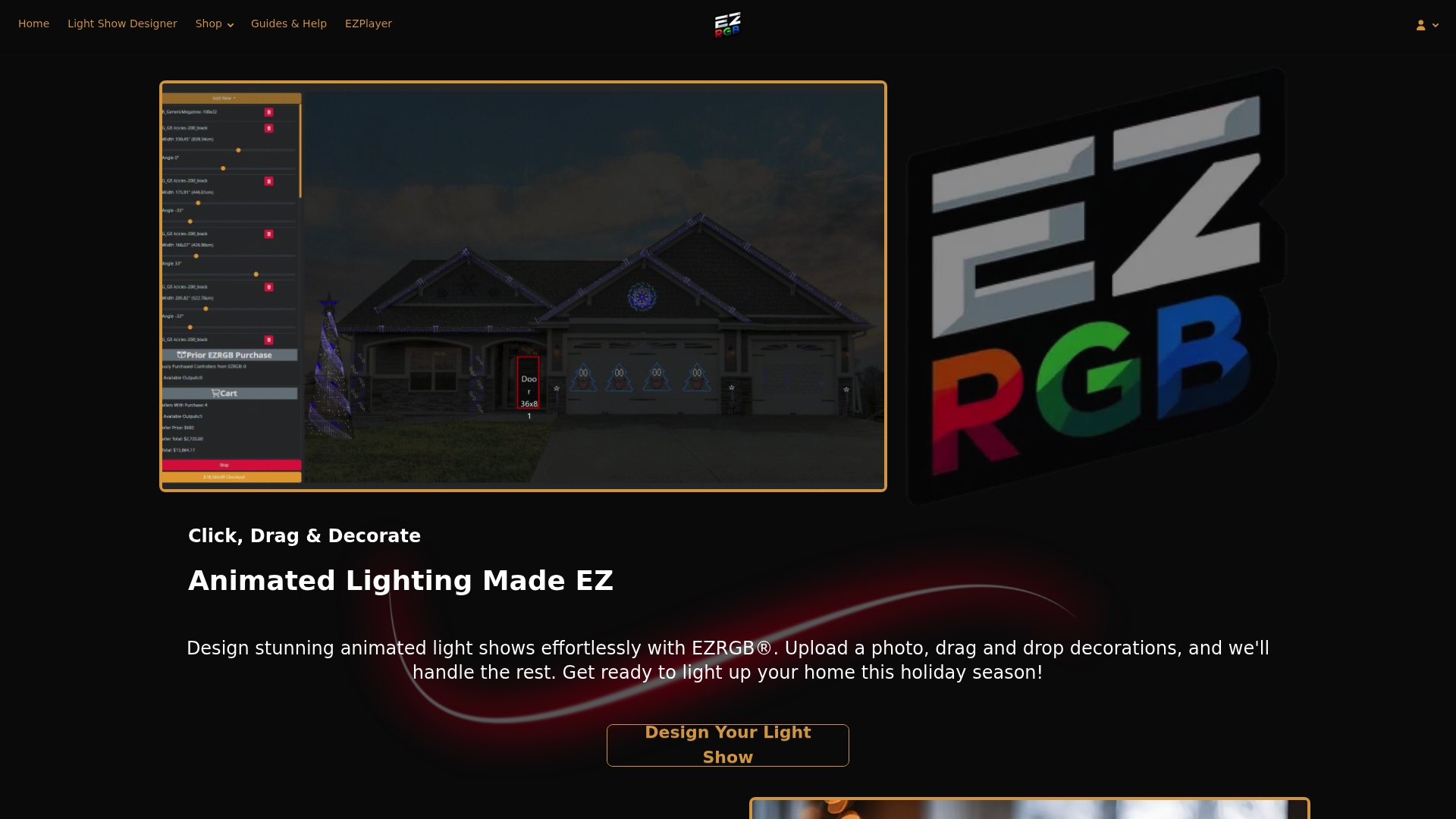
Upload a photo of your house to the EZRGB layout designer.
-
Set the scale. Draw a box around a measured door or window and enter its dimensions. The designer scales the photo and estimates prop sizes and light counts. EZRGB determines the equipment that goes with your layout.
-
Drag and drop decorations onto the photo and review the layout. Its drawing tools cover rooflines, curved lines, doors and windows.
-
Generate your sequence. EZSequence builds a sequence that follows your layout.
-
Play and schedule it. The installed EZPlayer application syncs the show and configures the controllers. Website access lets you manage the registered player’s playlists and schedule.
A few practical details to know up front. The EZRGB kit workflow requires an internet connection to the cloud. EZPlayer can sync over Wi-Fi, and all controllers connect by Ethernet. Sequences and music are sold separately from kits.
Grow the layout when you are ready
You can add props or RGB lights in the designer whenever you want. It tracks available controller ports and identifies when additions require another controller. When the updated show syncs, EZPlayer reprograms the controllers to fit the new design. Its connection guidance tells you which prop goes where; installation photos are optional for memories rather than a requirement for rebuilding the show.
Keep color expectations separate from equipment planning. EZRGB determines the equipment for your layout, while a physical sample is the best way to compare a white appearance with existing lights. Check the exact product listing and ask EZRGB about any product-specific color question before purchasing.
Ready to build your display
If you want an animated show instead of static strings, start with our plug and play kits. Kits include their listed equipment and extensions. Mounting is excluded because every house differs, and the cloud workflow configures controllers for your design. Add individual plug and play props where you want emphasis, and choose from our RGB sequences for lighting arrangements; sequences and their matching music are purchased separately.
If your roofline is the priority, take a look at the Roofline Special. For layout and safety, our guides to festive exterior lighting design and weather-proof outdoor lighting cover the next steps.
FAQ
Is warm white or cool white better for Christmas lights?
Neither is better in every case. Warm white gives a cozy, traditional look, and cool white gives a crisper, more modern one. Choose by your home’s materials and the decorations you already have, then view a sample before you commit.
Is cool white brighter than warm white?
Not necessarily. Cool white can look sharper because of its bluish tone, but tone and brightness are different properties. A warm and a cool light can have similar output and still look different.
Can I mix warm white and cool white in one display?
Yes, if you do it on purpose. Keep one tone dominant in each area and use the other as a small accent, such as a few icy snowflakes on a warm roofline. View the combination on your own home to decide whether it fits your theme.
Do EZRGB lights have a warm white or cool white setting?
EZRGB pixels are RGB pixels, and we do not claim a dedicated white channel, calibrated Kelvin settings or identical whites across products. Use the layout designer to preview the look on your own house, and check the official product listing for product-specific details.
